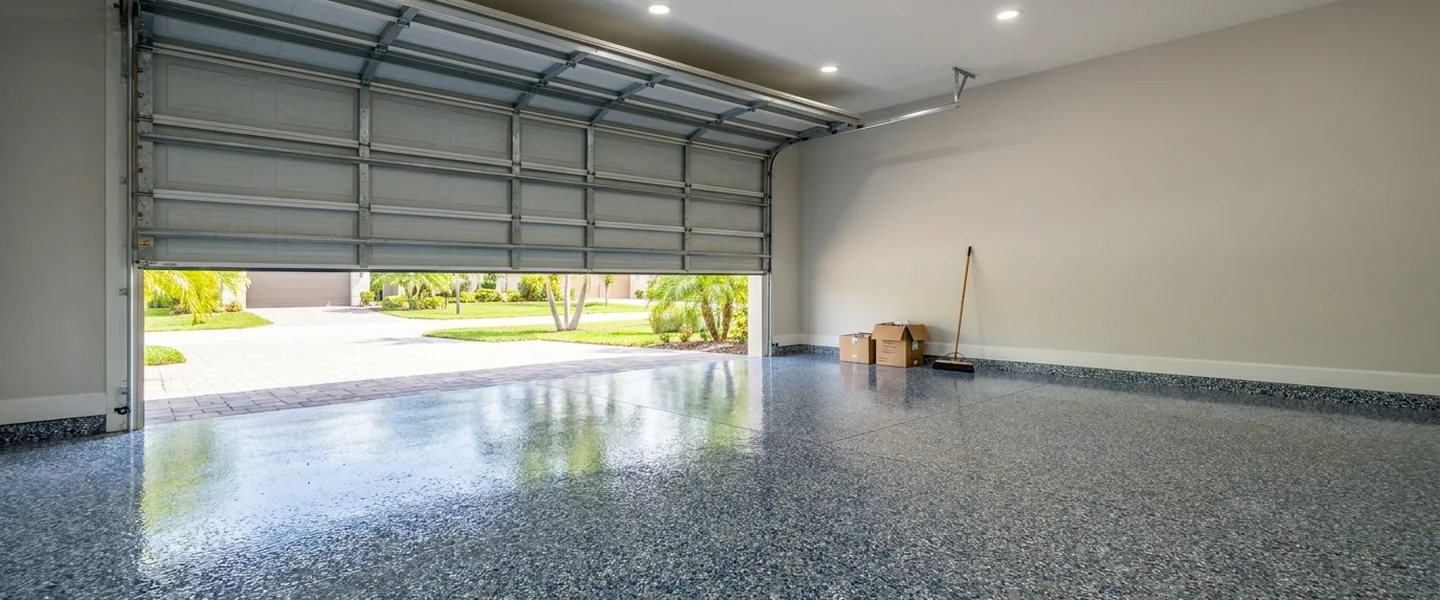
Epoxy Floor Coating in Fort Myers, FL
Professional garage floor epoxy and polyaspartic coatings for Fort Myers — Lee County's urban core, from McGregor Blvd's historic corridor to the newer east Fort Myers developments, with MVE testing and 15-year finish warranty.
Call (239) 522-7746 — Free EstimateFort Myers is Lee County's seat and its largest urban center — a city of 87,000 that anchors the broader Southwest Florida metro area stretching from Bonita Springs in the south to Cape Coral across the Caloosahatchee River. The city's housing stock spans from the historic McGregor Boulevard corridor lined with royal palms and Craftsman bungalows from the 1920s–1940s to the suburban grid neighborhoods built during the postwar boom, and from the established midcentury communities east of US-41 to the newer master-planned developments pushing toward Alico Road and beyond.
That range of housing age, style, and condition means Fort Myers garage floor coating projects span the full spectrum — from first-time coating on a freshly poured slab in a 2018-era subdivision to complete removal and reinstallation on a slab that's seen four decades of Florida heat, vehicle oil, and failed hardware store kit attempts. We serve all of Fort Myers with the correct assessment and specification for each situation. Call (239) 522-7746 for a free on-site estimate.
Fort Myers Garage Floors — Zone by Zone
McGregor Boulevard Corridor and Historic Districts
The McGregor Boulevard area — extending from downtown Fort Myers toward Sanibel Causeway — represents some of Lee County's oldest residential housing stock. Homes built from the 1920s through 1960s have smaller garages, often single-car with minimal overhead clearance, and slabs that have accumulated decades of use. The historic character of the neighborhood means homeowners here often care deeply about the appearance of every space, including the garage. These older slabs require careful assessment — settlement cracking is common, oil contamination from long years of vehicle parking requires degreasing treatment, and in some cases, a failed DIY coating from the 1990s or early 2000s needs mechanical removal before the new system can go down.
The proximity to the Caloosahatchee River and the Gulf approach via Matanzas Pass creates meaningful salt-air exposure for properties in the western McGregor corridor — not as intense as Marco Island's direct Gulf exposure, but sufficient to disqualify aromatic epoxy topcoat chemistry for long-term performance. Aliphatic polyaspartic is our standard topcoat specification regardless of proximity to water; the McGregor corridor is a location where that specification matters most.
Midcentury Suburban Neighborhoods (1960s–1980s)
The bulk of Fort Myers' residential housing stock was built during Southwest Florida's growth decades of the 1960s through 1980s — concrete block homes on slab foundations with attached or detached one and two-car garages. These properties represent our most common Fort Myers job type: a slab that's 40–60 years old, has seen decades of vehicle use, needs oil degreasing and crack repair, and has never had a professional coating system applied. The transformation from a cracked, stained concrete floor to a finished polyaspartic-topcoated system is dramatic in these spaces.
One consideration specific to this housing era: many Fort Myers garages from the 1970s–1980s have slightly lower ceiling height than current construction — 7'6" to 8'0" — and the slab is often slightly below finished floor level of the home. This affects surface water drainage into the garage during heavy rain events, which is worth noting during the assessment because it can influence the topcoat's slip-resistance specification.
Established East Fort Myers and Gateway Corridor
The neighborhoods east of I-75 along Colonial Boulevard, Daniels Parkway, and the gateway corridor to the airport represent 1990s–2010s construction — standard suburban homes with two-car garages and concrete slabs that are now in the 10–30 year age range. This is the most active epoxy coating market in Fort Myers: owners who've been in the home long enough for the slab to show wear, but the home is still relatively modern in every other respect. The garage floor is often the last unfinished space.
Slabs in this construction era are old enough that residual construction moisture has largely dissipated, but Lee County's high water table still produces meaningful MVE readings on many properties — especially those with lower terrain elevation and poor drainage characteristics beneath the slab. Testing is the only way to know where a given slab falls.
Newer South Fort Myers and Estero Edge Communities
The newer developments in south Fort Myers — Treeline Corridor, Pelican Preserve, Colonial Lakes, and communities along Alico Road near Florida Gulf Coast University — have housing built predominantly from 2005–2020. These newer slabs have higher initial MVE than their older counterparts; the residual moisture from the original concrete pour continues migrating through the slab for 3–7 years after placement, regardless of how new the home looks. A 2018 Fort Myers slab may test at higher MVE than a 1985 McGregor Boulevard slab — concrete age and moisture content are not directly correlated.
What We Typically See in Fort Myers Garages
33901 / 33907 (McGregor and downtown-adjacent): Older housing stock, single and double-car garages, settlement cracking, oil contamination, occasional failed DIY coating from prior decade attempts. These properties need the most thorough assessment and preparation — but the finished result in these historic homes is striking.
33908 / 33919 (South Fort Myers, Iona, Cape Harbour area): Mixed-age housing from the 1970s through 2000s, some canal-front and waterfront properties with salt-air exposure requirements, two-car standard garages. The Iona area in particular has a significant number of canal-front properties along the Imperial River tributaries where aliphatic polyaspartic topcoat is essential.
33912 / 33913 (Gateway, east Fort Myers, Colonial Blvd corridor): Mid-era construction from the 1990s–2010s, standard two and three-car garages, gateway community properties near RSW airport. Most common job profile in this zip zone: first professional coating on a 15–25 year old slab, clean preparation, standard flake broadcast system, 15-year warranty.
33966 / 33967 (Treeline, south Fort Myers near FGCU): Newest construction zone in Fort Myers, 2005–2020 build era, elevated initial MVE common, larger garage footprints. Homeowners here tend to research specifications thoroughly before calling — which we welcome. MVE testing is especially important in this newer-construction zone.
Services We Provide in Fort Myers
- Garage Floor Epoxy Coating — full two-day system, MVE testing, diamond grinding, aliphatic polyaspartic topcoat, 15-year warranty
- Polyaspartic Floor Coating — single-day option for clean Fort Myers slabs where assessment confirms suitability
- Metallic Epoxy Floors — custom metallic systems for McGregor Blvd and south Fort Myers luxury garages
- Lanai and Patio Floor Coating — UV-stable, slip-resistant polyaspartic for Fort Myers lanais and pool decks
- Concrete Repair + Coating — crack filling, oil degreasing, failed coating removal and replacement for older Fort Myers slabs
- Commercial Epoxy Flooring — US-41, Colonial Blvd, and Daniels Pkwy commercial corridor properties
Free Epoxy Floor Estimate — Fort Myers, FL
From McGregor Blvd to the Treeline Corridor — same crew, same system, same 15-year warranty across all of Fort Myers.
Call (239) 522-7746Epoxy Flooring FAQ — Fort Myers
Do you serve all of Fort Myers including south Fort Myers near Estero?
Yes — we serve all Fort Myers zip codes including 33901, 33907, 33908, 33912, 33913, 33919, 33966, and 33967. The south Fort Myers communities near Estero and the Treeline corridor are fully within our standard service area. We also serve the Gateway community and developments near RSW airport. Call with your specific address if you're uncertain about coverage.
My Fort Myers home is near the water — does that change the coating specification?
For properties with direct waterfront access or canal frontage — particularly those west of US-41 and along Iona Road and the Imperial River tributaries — the aliphatic polyaspartic topcoat is especially important. Salt-air exposure at these locations is sufficient to accelerate degradation of standard epoxy topcoat chemistry. Our standard specification uses aliphatic polyaspartic on every job, so you're covered without requesting an upgrade. If you've gotten quotes using standard epoxy topcoat for a waterfront location, that's worth asking about.
Can you remove a failed epoxy coating from a Fort Myers garage?
Yes. Failed coating removal — whether it's a hardware store kit that blistered, a contractor job that hot-tire peeled, or a coating that yellowed and delaminated — is a common job type in Fort Myers. We assess the failure mode during the site visit to understand why it failed, remove the coating mechanically, test the slab for MVE (often the cause of prior failures), and install a system that addresses the root cause. The removal adds preparation time and cost, but the result is a properly installed 15-year warranted floor rather than a repeat failure.
How does the Florida heat affect the epoxy installation process in Fort Myers?
Fort Myers heat and humidity affect application windows — we monitor ambient temperature and relative humidity carefully during installation to ensure epoxy and polyaspartic products cure within their specified parameters. We schedule application to avoid the hottest part of the afternoon when possible, and we use products with appropriate pot life for Southwest Florida conditions. The aliphatic polyaspartic topcoat we use is engineered for high-UV, high-temperature environments, which is why it outperforms standard aromatic epoxy topcoats in the Fort Myers climate. Year-round Florida sun means UV stability isn't a seasonal concern — it matters every day.
Nearby Service Areas
We also serve Cape Coral, Estero, and Bonita Springs. See the Naples Epoxy Floor Pros homepage for the full service area.
← Back to Naples Epoxy Floor Pros Home | Garage Floor Epoxy | Concrete Repair