Polyaspartic Floor Coating in Naples, FL
UV-stable, hot-tire resistant aliphatic polyaspartic floor coatings for Naples garages and commercial spaces — the topcoat that Florida's climate actually demands.
Call (239) 522-7746 — Free EstimateAliphatic polyaspartic urethane is the topcoat chemistry that Southwest Florida's climate actually requires. It's UV-stable, so it doesn't yellow under Naples' year-round sun exposure. Its glass transition temperature is significantly above Florida's peak summer conditions, so hot tires don't lift it. It cures faster than epoxy — which matters for installation scheduling in Florida's humidity — and it performs without degradation for 15+ years in coastal subtropical environments.
We include aliphatic polyaspartic topcoat on every job we install. It's not an upgrade or an add-on — it's the standard specification for every coating system we sell because the Florida climate makes anything less inadequate for long-term performance. Call (239) 522-7746 for a free on-site estimate.
Polyaspartic vs. Epoxy Topcoat — Why It Matters in Florida
The topcoat is the outermost layer of a garage floor coating system — it's what you see, what vehicles touch, and what takes direct UV exposure. The topcoat determines how the floor performs against hot tires, UV light, chemicals, and daily wear. Specifying the wrong topcoat chemistry for Florida produces predictable failures:
Standard Epoxy Topcoat
UV stability: Poor — yellows and chalks within 1–2 years of UV exposure through garage door openings. Hot-tire resistance: Poor — softens above its glass transition temperature, which Florida summer conditions routinely exceed. Result: Yellow, peeling floor within 2–3 years in SW Florida.
Aliphatic Polyaspartic Topcoat
UV stability: Excellent — no photodegradation, maintains color and gloss under continuous UV exposure. Hot-tire resistance: Excellent — Tg well above Florida temperature peaks; tires don't bond to the surface. Result: Performs to 15-year warranty specification in SW Florida's full climate range.
This comparison applies specifically to the topcoat layer — the base coat in our system is 100% solids epoxy, which is appropriate for the base coat application under a polyaspartic topcoat. The epoxy base coat doesn't see UV exposure or direct tire contact, so its topcoat-specific limitations don't apply to its base coat role.
Single-Day Polyaspartic System
For Naples area properties where a single-day installation is preferable — snowbird properties with tight access windows, light-use garages on simpler slabs, or situations where the two-day downtime isn't workable — we offer a single-day polyaspartic system.
A single-day polyaspartic-only system (no separate epoxy base coat) can be completed in one day on a clean, well-prepared slab with acceptable MVE levels. The tradeoff: less total film build than our standard two-day epoxy + polyaspartic system. The single-day system is appropriate for light-use garages and simpler slabs; the two-day system is the better long-term investment for daily-use garages and slabs with more challenging conditions.
We'll recommend which system is appropriate for your specific slab after the on-site assessment. We don't push the two-day system on every job — some slabs and some use cases are well-served by the single-day option.
Project Details
| System Options | Two-day (epoxy base + polyaspartic topcoat) or single-day (polyaspartic only) |
|---|---|
| Topcoat Chemistry | Aliphatic polyaspartic urethane — UV-stable, hot-tire resistant |
| Finish Options | High gloss, satin, or matte |
| Flake Broadcast | Available with both system types — full-broadcast vinyl flake |
| Cure Time | Touch-dry 2–4 hours; park-ready 24 hours; full cure 72 hours |
| Pricing | Quoted per job after free on-site inspection — every quote is itemized in writing |
| Warranty | 15-year finish warranty on full two-day system |
| Service Area | Naples, Marco Island, Bonita Springs, Estero, Golden Gate, Cape Coral, Fort Myers |
Polyaspartic for Florida's Coastal Environment
Marco Island and beachfront Naples properties add salt air to the already demanding Florida coating environment. Aliphatic polyaspartic is specified for coastal industrial and architectural applications because it resists the combined UV, moisture, and salt air exposure that coastal environments deliver. A floor coating on Marco Island needs to perform under conditions that would accelerate the degradation of lower-spec systems significantly faster than an inland Naples property. Aliphatic polyaspartic is the right chemistry for both; it's especially critical for coastal properties.
How We Apply Polyaspartic — The Process
Polyaspartic application sequence differs from standard epoxy application because of its faster cure chemistry. The correct application process for a full two-day system:
- 1Diamond grinding (Day 1 morning): Walk-behind planetary grinder removes the surface layer and creates the mechanical profile for adhesion. Vacuum shroud captures concrete dust throughout grinding.
- 2Surface preparation (Day 1 mid-morning): Cracks filled with semi-rigid epoxy filler, oil contamination treated with commercial degreaser and re-ground, perimeter detailed with edge grinder. Vapor-block primer applied if MVE test indicates elevated moisture.
- 3Epoxy base coat and chip broadcast (Day 1 afternoon): 100% solids high-Tg epoxy base coat applied in 10–15 mil wet film thickness. Vinyl flake broadcast immediately into wet epoxy while still open. Floor cures overnight.
- 4Chip scrape and vacuum (Day 2 morning): Protruding chips scraped flat, floor vacuumed clean. Base coat surface inspected for holidays or defects before topcoat application.
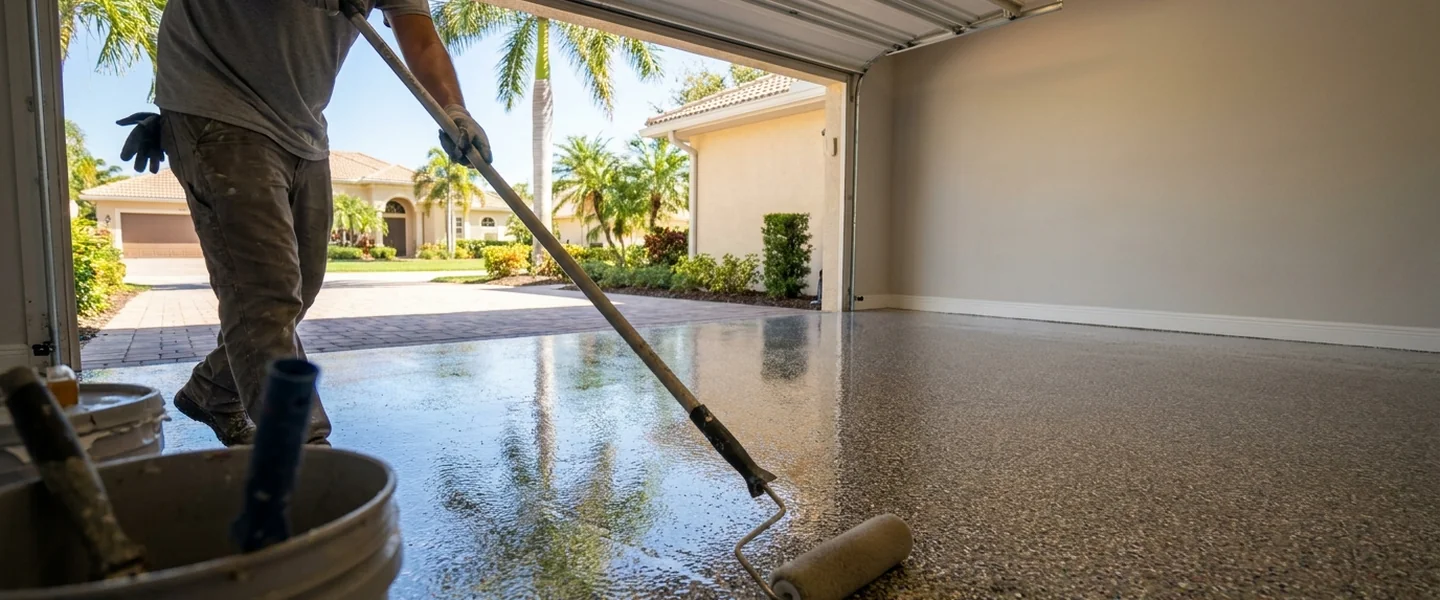
- 5Aliphatic polyaspartic topcoat (Day 2 morning/midday): Two-part aliphatic polyaspartic mixed and applied in 4–6 mil wet film thickness by roller. Application conditions (ambient temperature and humidity) verified before mixing — polyaspartic has a shorter pot life than epoxy and requires working in sections. Florida summer heat means we target early morning for topcoat application.
- 6Final inspection and cure: Completed floor inspected for uniform coverage, defects, and edge work. Light foot traffic possible within 4–6 hours; vehicle traffic after 24 hours; full chemical cure at 72 hours.
After the Polyaspartic Install — First 7 Days
Polyaspartic cures significantly faster than epoxy, but full chemical cure — when the floor reaches its design performance parameters including maximum Tg — takes 3–7 days depending on temperature and humidity. During the first week:
- Hours 0–6: Keep traffic off the floor entirely. Polyaspartic sets faster than you expect but is still developing green strength.
- Hours 6–24: Light foot traffic acceptable. Avoid dragging objects or dropping tools on the new surface.
- 24–72 hours: Vehicle parking acceptable with normal entry and exit — pull straight in, don't spin tires, avoid sharp pivot turns. No rubber mats or area rugs during this period (rubber can interfere with final cure development).
- 72 hours – 7 days: Normal use appropriate. Golf carts, workshop equipment, and standard vehicle traffic all fine. The coating continues gaining hardness throughout this period but is fully functional for normal residential use.
- After 7 days: Full chemical cure achieved. The floor performs to its design specification: 15-year warranty conditions, maximum Tg, full chemical resistance. Standard cleaning with a neutral pH cleaner is appropriate from this point forward.
Common Misconceptions About Polyaspartic Coatings
"All polyaspartic is the same." False — the key distinction is aliphatic vs. aromatic chemistry. Aliphatic polyaspartic is UV-stable; aromatic polyaspartic degrades under UV just like standard epoxy. Some contractors market "polyaspartic" systems that use aromatic chemistry — cheaper to buy but inferior performance in Florida conditions. Ask specifically for "aliphatic polyaspartic" and request the product data sheet to verify.
"One-day polyaspartic is always better because it's faster." Speed is not the same as performance. A one-day polyaspartic-only system skips the high-Tg epoxy base coat — which means less hot-tire lift resistance and less adhesive bond to the concrete. For clean, light-use slabs the single-day system is appropriate. For daily-use garages and slabs with preparation requirements, the two-day system is the better long-term value regardless of the extra day.
"Polyaspartic coatings don't need MVE testing because they cure faster." False — vapor-block primer is a slab preparation step that addresses moisture condition in the concrete, not coating cure speed. A fast-curing polyaspartic applied directly to a high-MVE slab without vapor-block primer will blister just as surely as a slow-curing epoxy. Testing and vapor-block primer decisions are independent of topcoat chemistry.
"The cheaper the system, the same the result." Coating product cost represents a small fraction of a professional installation's total cost (labor, equipment, prep materials). Contractors who cut product cost are cutting performance specification — the difference between aliphatic and aromatic polyaspartic topcoat is not visible at application time but is very visible at year three.
Polyaspartic Coating FAQ — Naples
What's the difference between polyaspartic and polyurea?
Polyaspartic is a subcategory of polyurea chemistry. Both are urethane-based, but aliphatic polyaspartic has better UV stability and more controlled cure speed than many polyurea formulations. "Polyurea" is sometimes used as a marketing term for fast-cure coatings that aren't truly aliphatic — ask specifically for "aliphatic polyaspartic" and ask to see the product data sheet. The PDS will confirm whether the product is aliphatic (UV-stable) or aromatic (UV-unstable).
Is polyaspartic appropriate for a lanai or outdoor patio?
Yes — aliphatic polyaspartic is one of the best choices for screened lanais and covered patios in Florida because of its UV stability and moisture resistance. See our Lanai and Patio Floor Coating service page for details specific to outdoor and semi-outdoor applications.
Does polyaspartic work in the humidity of SW Florida's rainy season?
Yes, with proper application conditions monitoring. Polyaspartic has humidity limits for application — we monitor conditions and don't apply topcoat when ambient humidity is outside the product's specification range. Rainy season application requires more scheduling attention than dry season, but we manage this routinely in Southwest Florida.
Is the single-day polyaspartic system appropriate for my garage?
It depends on your slab condition and use intensity. Simple, clean slabs in light-use garages with acceptable MVE levels are good candidates for the single-day system. Daily-use garages, slabs with cracks or contamination, and properties with elevated MVE are better served by the full two-day epoxy + polyaspartic system. We assess the slab during the on-site visit and give you an honest recommendation.
Free Polyaspartic Floor Estimate — Southwest Florida
UV-stable. Hot-tire resistant. 15-year finish warranty. Written quote, same-week scheduling.
Call (239) 522-7746← Back to Naples Epoxy Floor Pros Home | Garage Floor Epoxy | Lanai + Patio Coating