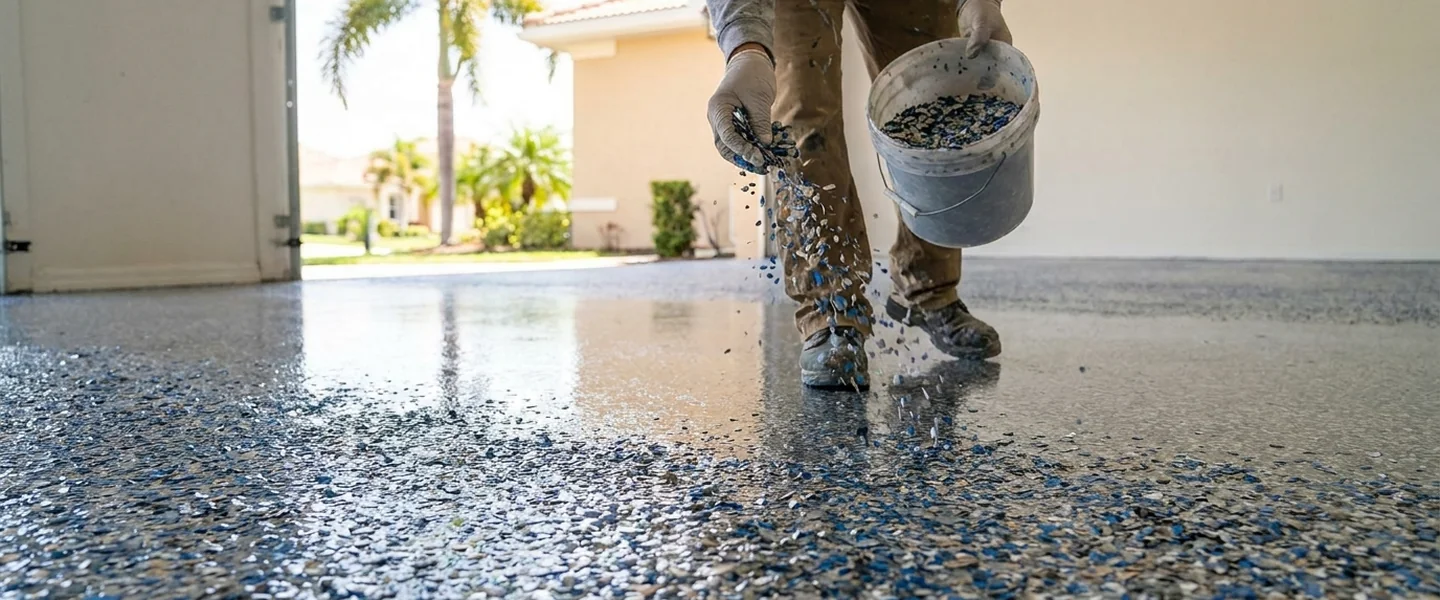
Garage Floor Epoxy Coating in Naples, FL
Professional garage floor coating for Southwest Florida — diamond grinding, moisture vapor testing, 100% solids epoxy base, and aliphatic polyaspartic topcoat built to handle Florida's humidity, heat, and year-round hot-tire conditions.
Call (239) 522-7746 — Free EstimateGarage floor coating in Southwest Florida is not the same job as garage floor coating in a temperate northern climate. Florida's humidity, shallow water table, and year-round heat create conditions that cause inferior coating systems to fail within 1–3 years — blistering from moisture vapor pressure, peeling at tire contact zones, and UV yellowing from constant sun exposure through garage door openings. A coating system designed for these conditions looks completely different from a system designed for a garage in Ohio.
We install a three-component system specifically engineered for Florida's demands: diamond-ground adhesion profile, 100% solids epoxy base with moisture vapor barrier primer when testing indicates elevated MVE, and aliphatic polyaspartic topcoat that doesn't soften in heat, doesn't yellow in UV, and doesn't lift when hot tires roll off Tamiami Trail into your garage. Call (239) 522-7746 for a free on-site assessment in Collier or Lee County.
Why Florida Garage Floors Fail — And What We Do Differently
Moisture Vapor Emission — The Primary Failure Mode in SW Florida
Southwest Florida's slab-on-grade construction sits over soil with a high water table and significant clay content in many areas. Water vapor migrates upward through the concrete slab from below — a process called moisture vapor emission (MVE). When a coating is applied over a slab with elevated MVE without a vapor-block primer, the vapor pressure builds beneath the coating and the coating delaminates from the concrete surface. The result: dome-shaped blisters distributed across the floor, typically appearing within the first one to two years after installation.
MVE is the most common cause of garage floor coating failure in Naples, Bonita Springs, Marco Island, and throughout Collier and Lee County. It's also entirely preventable with proper testing before installation and vapor-block primer application where testing indicates it's needed.
We perform MVE testing on every slab before installation. If testing indicates elevated vapor emission, we apply a vapor-block epoxy primer that seals the slab surface and prevents vapor pressure from reaching the coating system above. This adds a step and a material cost — but it's the step that separates a coating that lasts 15 years from one that blisters in the first Florida rainy season.
Hot-Tire Lift — A Year-Round Problem in Florida
In northern states, hot-tire lift is a summer problem. In Southwest Florida, it's a year-round problem. When ambient temperatures stay above 80°F for 10 months of the year and asphalt driveway surface temperatures routinely exceed 140°F, standard epoxy topcoats are constantly operating near or above their glass transition temperature (Tg) — the point at which the coating softens and becomes vulnerable to adhesive failure.
Aliphatic polyaspartic urethane has a significantly higher Tg than standard epoxy topcoats. At Florida's summer temperatures — garage floor surfaces reaching 120°F or more — aliphatic polyaspartic remains hard and non-adhesive to tire rubber. Hot-tire lift simply doesn't occur with a properly applied aliphatic polyaspartic topcoat. We include it on every job because the Florida climate demands it.
UV Degradation — Coastal Florida Sun Exposure
Standard aromatic epoxy topcoats yellow and chalk under UV exposure. In Naples, where the garage door is often open for significant portions of the day and sun angle delivers high UV doses, an aromatic topcoat degrades visibly within 1–2 years. The floor that was bright and glossy becomes yellow and dull.
Aliphatic polyaspartic is UV-stable by chemistry — it doesn't undergo the photodegradation reaction that causes aromatic epoxy yellowing. The floor you install in December looks the same in December ten years later. This is why aliphatic polyaspartic is used in exterior architectural coatings and aerospace applications — it maintains its properties under UV loads that destroy other coating chemistries.
Our Installation System
Moisture Vapor Emission Testing
We perform MVE testing before installation using in-situ RH probes drilled into the slab. Testing takes 24 hours. Results determine whether a vapor-block primer is needed and which primer is specified. We don't skip this step — MVE testing is what separates a coating that lasts from one that blisters.
Diamond Grinding — Adhesion Profile
We diamond-grind every slab with planetary grinding equipment. Diamond grinding opens the concrete surface, removes surface laitance, and creates the mechanical profile needed for epoxy adhesion. We don't acid-etch — acid etching doesn't produce adequate adhesion profile for a coating system that needs to last 15 years on a Florida slab.
Crack Repair and Surface Prep
Cracks are filled with semi-rigid epoxy filler — the same flexibility as the surrounding concrete prevents crack reflection through the coating. Oil contamination is removed with appropriate degreasers and re-ground. Spalled areas are filled and leveled before base coat application.
Vapor-Block Primer (When Indicated)
When MVE testing indicates elevated vapor emission, we apply a vapor-block epoxy primer that seals the slab surface. The primer cures before the base coat application. On slabs with acceptable MVE levels, we proceed directly to the base coat.
100% Solids Epoxy Base Coat and Flake Broadcast
The epoxy base coat is applied and immediately followed by full-broadcast vinyl flake — broadcast to rejection so the entire surface is covered. The base coat and flake system cures overnight before the Day 2 finish work begins.
Grout Coat and Aliphatic Polyaspartic Topcoat
Day 2: excess flake is scraped, a thin epoxy grout coat locks the flake layer, and the aliphatic polyaspartic topcoat is applied. The topcoat is UV-stable, hot-tire resistant, and chemical resistant. Floor is park-ready in 24 hours, fully cured in 72 hours.
Project Details
| Installation Timeline | 2 days (Day 1: grinding and base coat; Day 2: grout coat and topcoat) |
|---|---|
| MVE Testing | In-situ RH probe, 24-hour test — performed at estimate visit or separate pre-install visit |
| Base Coat | 100% solids epoxy, 100% solids content — no solvents, no water, maximum film build |
| Topcoat | Aliphatic polyaspartic urethane — UV-stable, hot-tire resistant, 15-year finish warranty |
| Flake Options | Multiple color blends — samples brought to every estimate visit |
| Finish Options | High gloss, satin, or matte polyaspartic topcoat |
| Pricing | Quoted per job after free on-site inspection — every quote is itemized in writing |
| Warranty | 15-year finish warranty — covers delamination, hot-tire lift, and UV degradation |
| Park-Ready | 24 hours after final topcoat application |
Southwest Florida-Specific Considerations
Seasonal Properties and Snowbird Scheduling
Many Naples and Marco Island properties are occupied seasonally — winter residents who are in SW Florida from November through April. Garage floor coating installation can be done during seasonal occupancy or during the summer vacancy period. We work with property managers and absent homeowners on access and scheduling. Summer installation on a vacant property is straightforward — we coordinate access with the property manager and send photos and documentation of the completed work.
One consideration for summer installation on vacant properties: if the home's AC is off during summer vacancy, the garage slab temperature is higher and the curing environment is more demanding. We factor this into installation planning and adjust product specifications accordingly when needed.
Hurricane Season and Garage Use
In Southwest Florida, the garage serves a secondary function during hurricane season: staging area for storm prep equipment, generator storage, and post-storm debris handling. A properly coated garage floor handles the rolling load of generators, wheelbarrows, and equipment without damage. Oil and fuel drips from generators clean easily off a polyaspartic topcoat with a mop — they don't stain or penetrate the coating surface.
Salt Air and Coastal Corrosion
Marco Island and beachfront Naples properties deal with salt air environments that accelerate degradation of coating systems not designed for coastal exposure. Aliphatic polyaspartic topcoats resist the UV and moisture combination of coastal environments significantly better than aromatic epoxy topcoats. For properties within a mile of the Gulf, the aliphatic polyaspartic topcoat isn't just recommended — it's the only specification that makes sense for longevity.
Materials We Use
| Diamond Grinding Equipment | Planetary diamond grinders with integrated vacuum systems — no dusty cleanup after grinding |
|---|---|
| Vapor-Block Primer | Two-component epoxy penetrating primer, ASTM F3010 compliant for slab moisture mitigation |
| Epoxy Base Coat | 100% solids, two-component epoxy — zero VOC, LEED compliant, maximum film build per coat |
| Crack Filler | Semi-rigid two-component epoxy filler — flexes with concrete movement to prevent crack reflection |
| Vinyl Flake | 1/4" decorative vinyl flake broadcast to rejection — multiple color blends available |
| Polyaspartic Topcoat | Aliphatic polyaspartic urethane — UV-stable, Tg significantly above Florida summer temperatures |
Warranty in Detail
Our 15-year finish warranty covers the performance of the complete installed system — what's covered and what isn't:
Covered: Delamination of the coating system from the concrete substrate (adhesion failure), hot-tire lift or topcoat peeling, UV yellowing or chalking of the topcoat, and flake loss from within the coating system.
Not covered: Damage from impacts (dropped heavy tools, vehicle damage), chemical spills from substances outside normal garage use, damage from flooding or standing water during hurricane events, concrete substrate movement or cracking after installation (we repair cracks before installation, but new cracking from slab movement is a substrate issue, not a coating failure).
The warranty is transferable to a subsequent property owner — a documented asset for a home sale in the Naples real estate market.
Garage Floor Epoxy FAQ — Naples
Why do so many Florida garage floor coatings fail quickly?
Three failure modes dominate in Southwest Florida: moisture vapor emission blistering (coating applied without MVE testing or vapor-block primer), hot-tire peeling (standard epoxy topcoat with Tg too low for Florida temperatures), and UV yellowing (aromatic epoxy topcoat used instead of aliphatic polyaspartic). All three are preventable with proper materials and preparation. A coating that fails in 1–2 years in Florida was either under-specified for the climate or installed without MVE testing.
Do Florida slabs always have moisture problems?
Not always, but the risk is significantly higher in SW Florida than in most of the country. We test every slab rather than assuming — some slabs test at acceptable levels and don't require vapor-block primer; others test high and must be treated before coating. The only way to know is to test. Skipping the test is how MVE blistering becomes your problem after installation.
How long before I can park in the garage after installation?
24 hours after the final polyaspartic topcoat application. Most customers park in the garage the morning after Day 2 completes. Full chemical cure is 72 hours — during this period avoid harsh chemical spills and heavy rolling loads on the floor.
Can you install in summer heat in Southwest Florida?
Yes — we install year-round in SW Florida. Summer installation requires monitoring product temperatures and ambient humidity during application. Epoxy and polyaspartic have application temperature and humidity ranges; we work within those ranges and adjust the schedule (early morning application, avoiding peak afternoon heat) when summer conditions require it. We don't skip summer jobs — we manage the conditions.
Can you coordinate installation with my property manager for a seasonal property?
Yes. We work with property managers throughout the Naples and Marco Island area for seasonal property installation. We coordinate access, send photo documentation during and after installation, and provide warranty documentation by email. You don't need to be present for the installation if a trusted representative has access to the property.
What flake colors are most popular in Naples area homes?
Neutral gray blends dominate — light to medium gray that coordinates with Naples' white, cream, and gray exterior color palettes. In Marco Island and beachfront communities, some homeowners choose tan and sand-tone blends that complement coastal aesthetics. We bring physical samples to every estimate so you can see the actual material in your specific garage lighting.
Is the 15-year warranty transferable if I sell the home?
Yes — the warranty transfers to a subsequent property owner with the sale of the home. We provide warranty documentation that can be included in the real estate transaction. A documented 15-year warranty on the garage floor is a verifiable asset for buyers in the Naples market.
How do I clean and maintain the epoxy floor after installation?
Standard maintenance: sweep or dust mop regularly to remove grit that can scratch the surface. Mop with a pH-neutral cleaner for deeper cleaning. Oil and chemical spills should be wiped up before they sit for extended periods — polyaspartic is chemical resistant but not impervious to concentrated chemicals left for hours. Avoid dragging sharp metal objects across the surface. Annual inspection of the floor condition allows early identification of any areas needing attention.
Free Garage Floor Estimate — Naples and SW Florida
On-site MVE testing. Written quote. 15-year finish warranty. Same-week scheduling throughout Collier and Lee County.
Call (239) 522-7746← Back to Naples Epoxy Floor Pros Home | Polyaspartic Coating | Concrete Repair