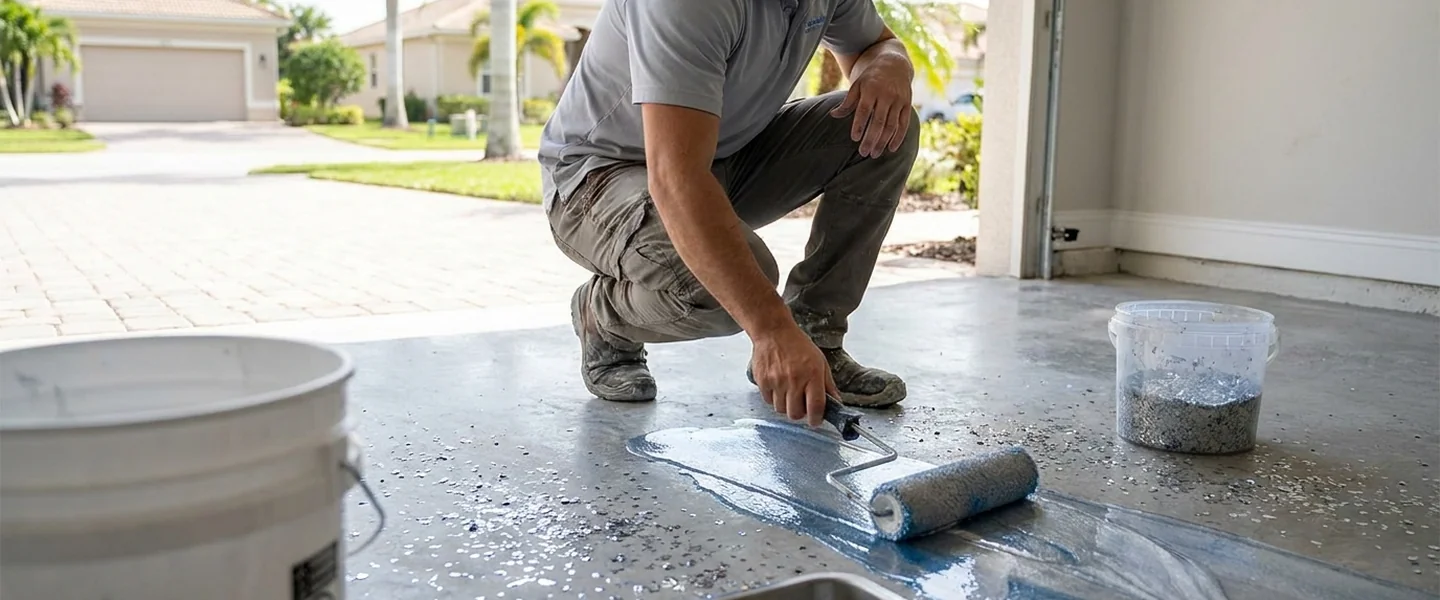
Concrete Floor Repair and Coating in Naples, FL
Crack repair, spall filling, oil contamination removal, and surface restoration for damaged Southwest Florida concrete slabs — proper prep that produces coatings that actually last.
Call (239) 522-7746 — Free EstimateA coating system is only as good as the surface it's applied to. Cracks that weren't filled before coating reflect through the finish within a season. Oil contamination that wasn't removed prevents adhesion and produces peeling within months. Spalled concrete that was painted over rather than filled creates an irregular, visually prominent surface that undermines the appearance of the coating above it. Proper concrete repair is preparation — not a separate service from coating, but the first phase of every coating installation we do.
For slabs with significant damage — major cracking, extensive spalling, oil contamination from years of vehicle use — the repair phase is more extensive and adds time to the installation. We assess all damage during the site visit and quote the full scope of prep and coating as a single job. There are no surprise repair surcharges after installation begins. Call (239) 522-7746 for a free assessment.
Florida Concrete Damage — Common Causes in SW Florida
Settlement Cracking From Sandy Soil
Southwest Florida's sandy soil and variable moisture content creates settlement conditions that cause concrete slabs to crack over time. When dry season soil shrinks and rainy season soil expands, the slab beneath the garage floor moves — and cracks. These settlement cracks are common in older Naples and Bonita Springs homes. Properly filled with semi-rigid epoxy filler before coating, settlement cracks don't reflect through the coating system. Skipped, they crack through any coating applied above them within 1–2 seasons.
Surface Spalling
Concrete surface spalling — shallow delamination of the top layer of the concrete, leaving a rough, irregular surface — occurs in Florida slabs for several reasons: freeze-thaw cycling from AC condensation on the slab surface during hot/cold transitions, aggregate popout from moisture exposure, and surface deterioration from cleaning chemicals applied to raw concrete. Spalled areas are filled and ground flat before coating — they can't be coated over and hidden without the irregularity showing through.
Oil and Chemical Contamination
Oil staining from vehicle leaks is the most common contamination issue in garage slabs throughout Naples and the surrounding area. Oil penetrates concrete over time — shallow stains can be surface-treated with degreasers and re-ground for adequate adhesion. Deep contamination that has penetrated significantly into the slab requires more aggressive treatment, and in some cases, oil-contaminated areas can't be adhesion-profiled to the point where epoxy will bond reliably without additional treatment steps.
We assess oil contamination depth and extent during the site visit. If contamination is severe enough to create adhesion risk that can't be fully mitigated, we tell you honestly — rather than installing over a problem area and leaving you with a peeling floor in 6 months.
Efflorescence
Efflorescence — white mineral deposits that form on concrete surfaces from water migrating through the slab — is common in Florida slabs with elevated moisture vapor emission. These deposits must be removed before coating; efflorescence on the concrete surface prevents epoxy adhesion. Diamond grinding removes surface efflorescence. Persistent efflorescence from ongoing high MVE requires vapor-block primer as part of the coating system specification.
Our Concrete Repair Process
Damage Assessment and MVE Testing
We walk the slab, map crack locations and types, assess spalling extent, evaluate oil contamination depth, and perform moisture vapor emission testing. The assessment determines the complete repair scope before quoting.
Diamond Grinding — Full Slab
Diamond grinding removes surface laitance, efflorescence, and existing coating residue while creating the mechanical adhesion profile needed for epoxy bonding. The entire slab is ground, not just damaged areas — adhesion profile must be consistent across the floor.
Oil Degreasing (Where Needed)
Oil-contaminated areas are treated with appropriate commercial degreasers, scrubbed, rinsed, and re-ground after treatment. Adhesion in treated areas is assessed before base coat application — we don't proceed over areas where adhesion is questionable.
Crack Filling With Semi-Rigid Epoxy
Cracks are filled with two-component semi-rigid epoxy filler — the same flexibility as the surrounding concrete movement prevents crack reflection through the coating. Filled cracks are allowed to cure, then spot-ground flush with the surrounding slab surface before base coat application.
Spall Repair and Leveling
Spalled areas are filled with epoxy filler or repair mortar appropriate to the depth and extent of spalling. Filled areas are feathered to blend with the surrounding slab and ground flush before coating. Deep spalls may require multiple fill passes.
Coating System Application
Once surface prep is complete and cured, the coating system is applied: vapor-block primer where indicated, 100% solids epoxy base coat, full-broadcast vinyl flake, grout coat, and aliphatic polyaspartic topcoat. The repair prep is what makes the coating last.
Project Details
| Crack Repair Material | Two-component semi-rigid epoxy filler — flexes with concrete to prevent crack reflection |
|---|---|
| Spall Repair Material | Epoxy repair mortar for shallow spalls; polymer-modified cement for deeper substrate repair |
| Oil Degreasing | Commercial solvent degreaser, mechanical scrubbing, re-grind — assessed for adhesion before proceeding |
| Efflorescence Removal | Diamond grinding — surface efflorescence removed mechanically |
| Pricing | Quoted per job after on-site damage assessment — repair scope and coating system quoted together |
| What We Can't Fix | Structural cracks from foundation movement (require structural engineering); severely oil-saturated slabs where adhesion can't be achieved |
| Warranty | 15-year finish warranty on completed system — repair areas covered under same warranty as undamaged areas |
Concrete Repair FAQ — Naples
Can all cracks in a concrete slab be repaired before coating?
Most settlement and shrinkage cracks can be filled and coated successfully. Structural cracks — cracks caused by ongoing foundation movement, slab heaving, or structural settlement — are a different matter. If a crack is actively moving (widening or shifting over time), filling it with epoxy produces a repair that re-cracks as the movement continues. We assess crack type during the site visit and distinguish stable cosmetic cracks (fillable) from active structural cracks (require structural assessment before coating).
What if the oil contamination in my garage floor is severe?
Severe oil contamination — years of leaks from a vehicle with multiple seals failing, for example — can penetrate deeply into the concrete matrix. Surface degreasing and re-grinding improves adhesion in these areas but may not eliminate the problem entirely. We assess contamination depth with a degreaser application test during the site visit. If contamination is deep enough that we can't achieve reliable adhesion in the affected area after treatment, we tell you before we start — not after the coating peels off the oil-saturated zone in six months.
Does the epoxy crack filler show through the finished floor?
Properly filled and ground cracks are not visible under a full-broadcast vinyl flake system. The flake pattern masks the repair line. Under a solid-color coating, repaired cracks may show as a subtle line depending on the crack width and color chosen — we advise on this during the estimate. Metallic epoxy systems can make crack repairs visible if the metallic pattern doesn't flow over the repair line consistently.
Can you repair a lanai slab that has significant cracking?
Yes — lanai slab cracking from settlement and thermal expansion is common in older Naples properties. We assess the crack type and pattern during the site visit. Settlement cracks in lanai slabs that have stabilized can be filled and coated. Active cracks from ongoing movement or inadequate slab support require addressing the underlying cause before coating.
Free Concrete Assessment — Naples and SW Florida
We assess the damage, quote the complete repair and coating scope, and give you an honest picture of what's achievable. Written quote, 15-year warranty.
Call (239) 522-7746← Back to Naples Epoxy Floor Pros Home | Garage Floor Epoxy | Polyaspartic Coating